
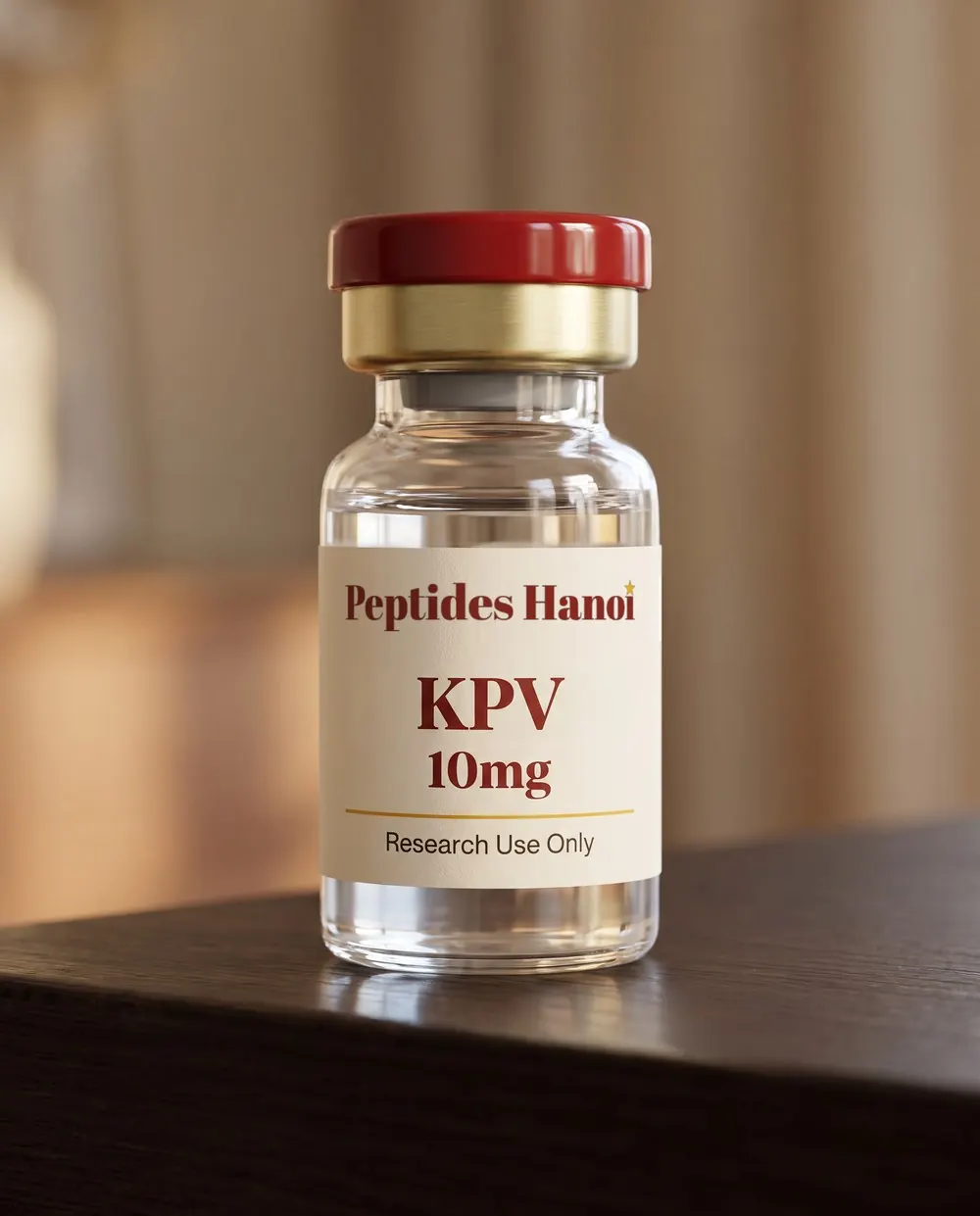
KPV 10mg peptide
KPV 10mg peptide: a research vial of KPV, a three amino acid peptide (lysine, proline and valine) studied in cells and rodents; all three KPV papers on this page, from 2008 to 2025, worked with cells or rodents.
2,400,000 VND ($95 USD) for 1 vial
Stock and the total are confirmed on WhatsApp.
USD prices are the store's dollar prices; you pay the VND price.
Free tracked delivery to Hanoi in 1 to 3 days, no minimum order. Each vial comes with a bottle of bacteriostatic water and a container. Research use only: not an approved medicine, and no medical advice.
What is KPV?
KPV 10mg is a three amino acid peptide (lysine, proline and valine). Its record covers cells and rodents and nothing more.
Lysine, proline and valine, in that order, make up KPV. Together they form the tail end of alpha-MSH, a hormone the body makes that is studied for its part in inflammation.
A good share of KPV papers are really about delivery systems, gels and very small particles, with KPV as the test cargo. Their results depend on the delivery system used.
What the 3 PubMed papers cited for KPV looked at, 2008 to 2025
Human gut cells and mice both featured in a 2008 study, which measured signals of inflammation in the cells and colon swelling in the mice, and traced how KPV enters the cells, through a carrier protein called PepT1.
In 2022, a study in rats with colon swelling tested KPV inside a sticky gel, and the team examined their gut lining.
Human skin cells were exposed to fine dust pollution in a 2025 lab study, with and without KPV, and the team measured cell death and IL-1 beta, an inflammation signal.
No human trial has been published; the work is in cells, mice and rats.
Sources: Gastroenterology 2008; Acta Biomater 2022; Tissue Cell 2025.
Reading the KPV record
KPV research has a pattern worth knowing. Many papers use it as a test cargo inside gels or tiny particles, so what they measure belongs partly to the delivery system. The 2022 rat study is an example: the peptide sat inside a sticky gel.
The 2008 study is the plainest of the three. It tested KPV in human gut cells and in mice, and it traced how the peptide enters gut cells, through a carrier protein called PepT1.
Its origin also explains the interest in it. Alpha-MSH, the hormone KPV comes from, is studied for its part in inflammation, and KPV is its last three amino acids. Nothing published tests the tail alone in people.
In the 2008 study, the peptide was tested in two settings: human gut cells in a dish and mice with colon swelling. That is why that study anchors this page.
Questions about KPV
Where does KPV come from?
It is the final three amino acids of alpha-MSH, a natural hormone, and the lab version matches that tail.
Has KPV been tested in people?
No. The published work cited here is in cells and rodents.
Why do so many KPV papers involve gels?
Many are delivery studies, with KPV carried inside a gel or tiny particles, so the results depend on the carrier.
KPV 10mg prices
| Pack | Total | Each vial | Per mg |
|---|---|---|---|
| 1 vial | 2,400,000 VND ($95 USD) | 2,400,000 VND ($95 USD) | 240,000 VND ($9.50 USD) |
| Pack of 3 | 5,832,000 VND ($230.85 USD) | 1,944,000 VND ($76.95 USD) | 194,400 VND ($7.70 USD) |
| Pack of 5 | 8,640,000 VND ($342 USD) | 1,728,000 VND ($68.40 USD) | 172,800 VND ($6.84 USD) |
| Pack of 10 | 14,400,000 VND ($570 USD) | 1,440,000 VND ($57 USD) | 144,000 VND ($5.70 USD) |
Near KPV in the list of 42
KPV is also one of the four peptides in KLOW 80mg, the entry before it. After it comes LL-37 5mg, another peptide from the body's own defences.
- BPC-157 + TB-500 20mg, 4,400,000 VND ($175 USD) a vial
- KLOW 80mg, 5,300,000 VND ($210 USD) a vial
- LL-37 5mg, 3,000,000 VND ($120 USD) a vial
- Thymosin Alpha-1 10mg, 3,900,000 VND ($155 USD) a vial